
Strategic Fundraise
Digital Assets • Stablecoins • Onramps • Offramps • Identity • Network
Jan 14th, 2026
Stablecoins • Digital Assets • Network • TOKEN2049
TOKEN2049 Singapore: Stablecoins are moving from experimentation to executionOctober 28th, 2026 | 3 mins
Three takeaways from TOKEN2049 Singapore on expanding payment corridors, cross-border payments and treasury management, and stablecoins for agentic AI.
The Meld team was on the ground at TOKEN2049 Singapore, connecting with fintechs, payment companies, wallets, and digital asset businesses from around the world.
Pankaj Bengani, Founder & CEO; Ed Padlan, CRO; and Sana Park, Partnerships, represented Meld during the event. Across conversations, one theme stood out:
Companies have spent the past few years adopting stablecoins. Now they want to know how to scale them.
Businesses need reliable local payout capabilities, consistent payment experiences, and scalable infrastructure across markets. Meld’s network is designed to simplify that complexity. Through a single API, Meld connects businesses to a global network of onramps, offramps, and payment providers, helping reduce the burden of managing fragmented integrations.
Here at Meld, our Network is what we have built: access to a global ecosystem of payment providers and local rails. Connectivity is what Meld enables: businesses can reach multiple markets and payment methods through one integration. Orchestration is how Meld creates additional value: intelligently coordinating and routing transactions across connected providers.
TL;DR: Meld connects and orchestrates fragmented payment infrastructure through one global network.
Given this background of what we have built, here are our three takeaways from Singapore:
Many companies have already established initial stablecoin payment corridors. Their next challenge is expanding into new markets without negotiating and integrating with local providers one by one. The need for broader, more accessible on/off-ramp infrastructure was one of the most consistent themes in our conversations.
Businesses increasingly see stacheck if allblecoins as infrastructure for international settlement, moving liquidity, and corporate payments. The discussion is shifting from theoretical benefits to operational requirements: reliability, coverage, cost, and integration complexity.
As AI agents become more capable of initiating and coordinating commercial activities, stablecoins are emerging as a potential payment mechanism for automated transactions. While these applications are still early, the convergence of AI-driven commerce and programmable money is worth watching.
TOKEN2049 reinforced a broader industry trend: stablecoins are increasingly being viewed as financial infrastructure rather than simply digital assets. But fragmentation remains a major obstacle to a seamless customer experience.
Localized payment orchestration, consistent identity and compliance processes, and developer-friendly APIs will help bridge traditional financial systems and blockchain networks. This matters most in emerging markets, where remittances, currency volatility, and limited access to traditional banking infrastructure drive demand for alternative payment solutions.
We left Singapore confident that global stablecoin adoption is advancing, but understanding the biggest challenge will be making global access feel local.
Let’s make global money movement simpler.
For more Meld insights, subscribe to our newsletter or follow us on X and LinkedIn.
Strategic Fundraise
Digital Assets • Stablecoins • Onramps • Offramps • Identity • Network
Jan 14th, 2026
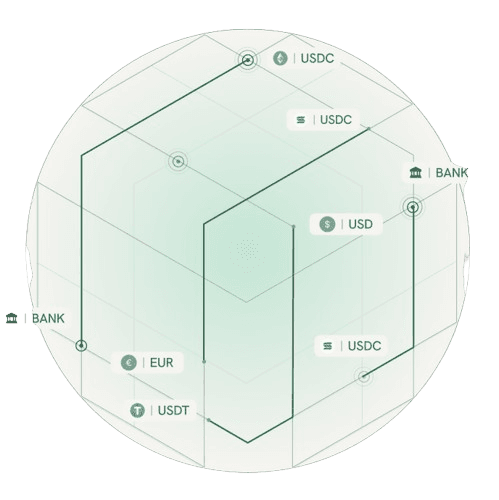
Introducing Meld Network: Access Digital Assets Anywhere
Digital Assets • Stablecoins • Identity • Network
Nov 18th, 2025
Meld Partners with Phantom to Enhance Global Crypto Access
Aug 19th, 2024