TOKEN2049 Singapore: Stablecoins are moving from experimentation to execution
Stablecoins • Digital Assets • Network • TOKEN2049
October 28th, 2026
Stablecoins • Cross-Border Payments • Digital Assets • Money20/20
Money20/20 USA: Stablecoins are giving businesses a competitive edge in cross-border paymentsNovember 18th, 2026 | 4 mins

Three takeaways from Money20/20 USA on last-mile settlement, scaling local infrastructure, and delivering a seamless stablecoin user experience.
The Meld team was on the ground at Money20/20 USA in Las Vegas, connecting with traditional financial giants, payment networks, fintechs, and digital asset businesses worldwide. Pankaj Bengani, Founder & CEO, and Ed Padlan, CRO, represented Meld at the event, taking the stage for a fireside chat at Stablecoin Day and an after-conference session with TaxBit.
What we have always known: While stablecoins offered an instant fix for sending money across borders, dealing with crypto wallets, hidden network fees, and complex compliance rules felt like too big a hurdle for companies and their customers.
But at Money 20/20 USA, major financial giants like Visa and Mastercard signaled that they have stopped treating digital currency as an experiment and started building it directly into their core networks. Instead of forcing businesses to figure out crypto on their own, these companies are wiring stablecoin speed right into the credit card and bank rails we already use every day.
For businesses paying international suppliers or managing cash across different countries, it means the money shows up in seconds instead of days.
Here are three takeaways from Las Vegas:
During his fireside chat at Stablecoin Day, Meld’s CEO Pankaj Bengani addressed where the promise of instant cross-border payments often breaks down. While a stablecoin transfer settles on-chain in seconds, the recipient is still waiting for usable funds to hit their local bank account or wallet. True end-to-end speed requires deep liquidity to convert digital dollars into local currency, paired with reliable payout providers to complete that final leg of delivery.
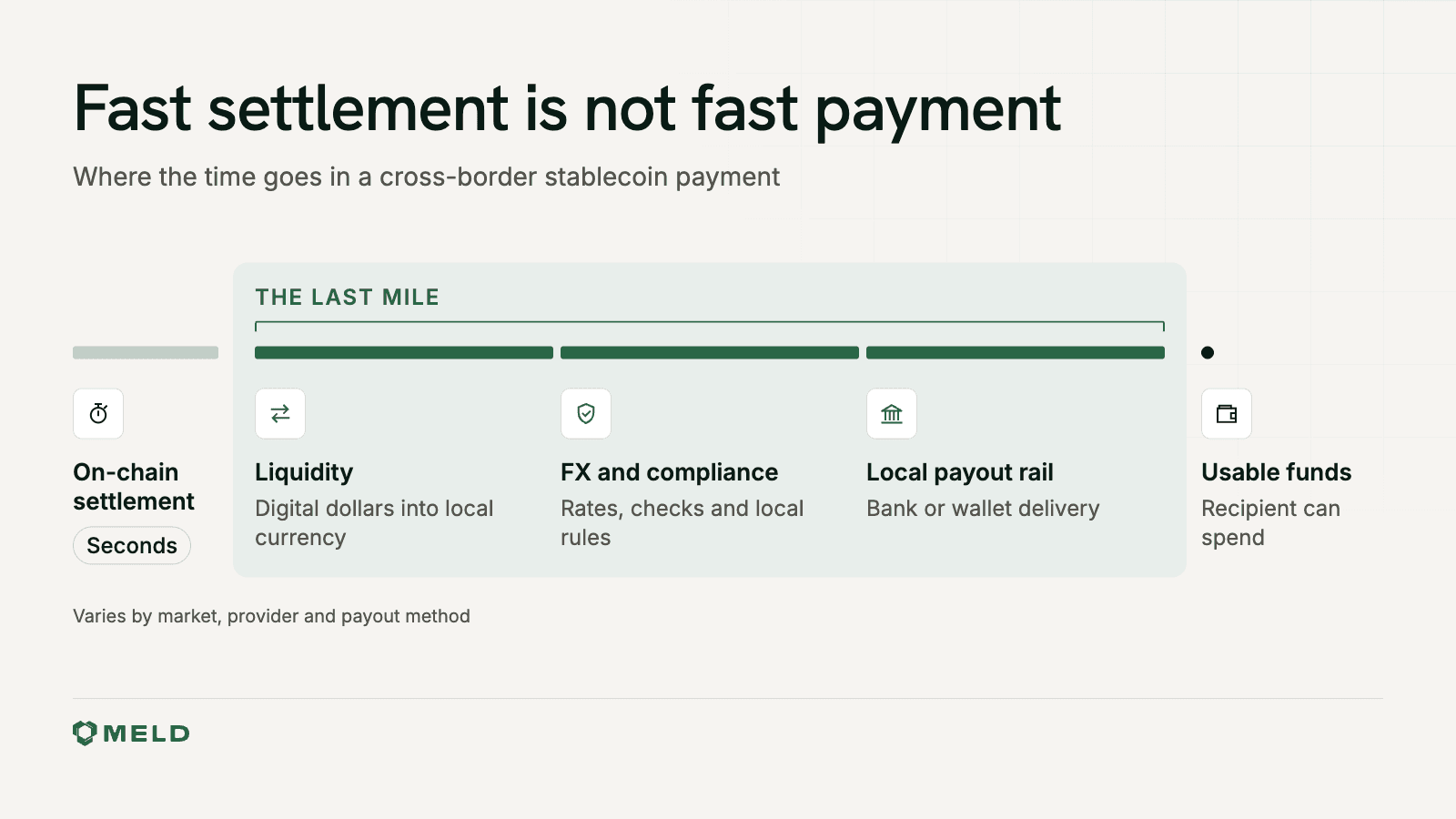
The fireside chat also explored the wave of new stablecoins being launched by banks, fintechs, and payment networks. More asset options can make it easier to initiate a transfer, yet they often complicate the last mile. Delivering funds globally still depends on which local providers support a specific asset, where they are licensed to operate, and how well they connect to domestic banking rails. For businesses expanding across multiple jurisdictions, routing payments through a single integration eliminates the heavy lift of building and maintaining dozens of isolated local connections.
In his panel discussion, Meld CRO Ed Padlan examined the user journey from a programmable wallet to a local payout. He noted that mainstream adoption requires a “Venmo moment”—an intuitive, seamless first experience rather than another technical explanation of blockchain rails. Just as early fintech apps simplified peer-to-peer transfers by hiding complex banking integrations in the background, cross-border stablecoin applications must do the same. Whether a business is paying an international supplier or a family in the Philippines is receiving a remittance, the recipient simply wants to know when the money arrives, what it costs, and how they can spend it. Liquidity, FX, and compliance have to operate invisibly under the hood to make that experience effortless.
Integrating stablecoin capabilities into companies’ existing cross-border payout architecture isn't an alternative anymore—it's an optimization strategy that is creating a competitive advantage.
The final test of cross-border stablecoin infrastructure is whether companies can deliver reliable payments as they add countries, currencies, and payout methods.
This convergence layer isn't about replacing traditional finance; it is about building a unified integration layer that natively connects existing banking networks with borderless rails. Instead of building separate, isolated token systems, we are moving toward an orchestration layer that solves the last mile of international commerce.
Let’s make global money movement simpler.
Expanding payout corridors? See where Meld has coverage.
For more Meld insights, subscribe to our newsletter or follow us on X and LinkedIn.
TOKEN2049 Singapore: Stablecoins are moving from experimentation to execution
Stablecoins • Digital Assets • Network • TOKEN2049
October 28th, 2026

Strategic Fundraise
Digital Assets • Stablecoins • Onramps • Offramps • Identity • Network
Jan 14th, 2026

Introducing Meld Network: Access Digital Assets Anywhere
Digital Assets • Stablecoins • Identity • Network
Nov 18th, 2025